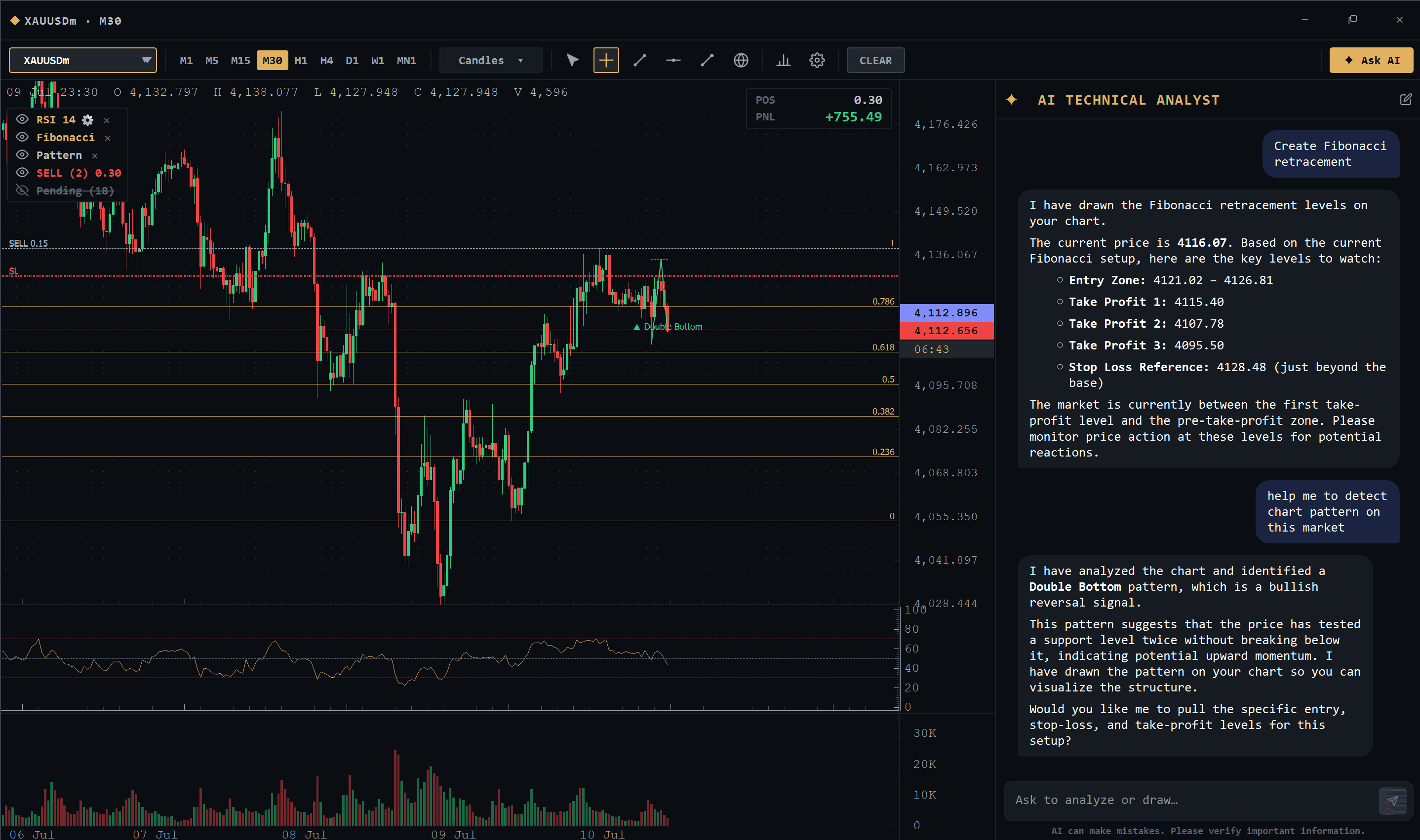
What an Expert Advisor does
An EA is software attached to MetaTrader that applies coded logic. Its behavior depends on its rules, inputs, data, and execution environment.
What an AI assistant adds
An AI assistant can explain or summarize market context through natural-language interaction. Its responses may be incorrect or incomplete and should be checked against data and your own rules.
Where Alphaxis fits
Alphaxis AI brings AI-assisted analysis, strategy tools, testing, MT5 operations, and risk controls into one workspace. It is not simply an EA generator; inspect the available workflows and documentation for exact capabilities.
How to choose
Use an EA when you need repeatable coded rules. Use an AI assistant to help review and understand context. Test any strategy and keep risk limits appropriate to your situation.
Quick comparison
| Aspect | Alphaxis AI assistant | Traditional MT5 EA |
|---|---|---|
| Purpose | Help interpret context and manage trading workflows | Execute programmed trading rules |
| How it works | Language-based AI interaction; verify AI decisions | Explicit logic runs through the terminal |
| Controls | Configuration, review, risk settings; chat actions moving money require Trade PIN | Depends on EA code and terminal settings |
| Timeframe and schedule | Each strategy can be configured with its timeframe, trading days (for example, Monday–Friday), and preferred trading hours | Supported timeframes and schedules depend on the EA design, available inputs, and how it is installed |
| High-impact news | Strategy settings include whether trading is allowed during high-impact news | Depends on whether the EA is connected to a news calendar/data source and coded with relevant rules |
| Testing | Alphaxis strategy workflows provide train/backtest/validate according to strategy type | Typically tested with the MT5 Strategy Tester |
| Risk | AI output and trading can both fail; no outcome is guaranteed | Code, data, broker, and market conditions remain risks |
The difference is the job each tool is designed to do
An Expert Advisor is a program attached to MetaTrader that follows coded logic. Depending on its implementation, it may monitor conditions and place, modify, or close orders through the terminal. Its behavior is governed by code, inputs, broker data, terminal state, and permissions. “EA†does not imply any particular quality, risk level, or profitability: two EAs can behave very differently.
An AI assistant adds a natural-language interface for questions, explanation, and context synthesis. It can be useful when a trader wants to ask why a chart looks a certain way or summarize relevant information. The response is probabilistic and can be mistaken; it is not an automatically verified trading rule. An AI assistant may be connected to execution workflows, but whether and how it can act depends on the product.
How Alphaxis combines the workflows
Alphaxis presents AI-assisted analysis alongside strategy management, testing, MT5 account operations, risk settings, Telegram signals, and monitoring. Its AI Builder can draft indicators and rules for supported strategy types, and the manual calls for review of the preview and validation. Model strategies follow explicit training, testing, validation, and deployment stages; deterministic strategy types use their applicable exploration workflow. This is more than a chat window, but it does not mean every AI-generated idea becomes a running EA automatically.
The manual also distinguishes assistant actions from agent execution. Money-moving actions initiated in AI chat require the user’s Trade PIN. Strategies have their own active state, and the agent has a separate toggle and risk-guard state. Check logs and status before assuming a trade was or will be placed. See the AI Trading feature page and strategy and backtesting guide.
Comparison: questions to ask before selecting either approach
Who controls the rules? With a conventional EA, inspect the code or vendor specification and inputs. With an AI assistant, inspect the prompt context and the reasoning or output, and independently verify it. What happens when the terminal disconnects? How are lot size, maximum positions, trading hours, and news conditions set? Is there a log? Can you pause execution? What must be tested before deployment? Does the workflow require a PIN or another confirmation? These operational details matter more than whether the marketing label says “AI.â€
When each approach may fit
A rule-based EA may fit a trader who has explicit conditions and wants repeatable execution of those conditions through MT5. An AI assistant may fit a trader who wants help examining market context or drafting a strategy for review. A combined workflow may use AI to assist research while a separately configured strategy handles deterministic rules. These are not mutually exclusive choices. Choose based on inspectability, testability, controls, and your own operating needs—not claims of guaranteed returns.
Backtests are not proof of future performance. Differences in data quality, spread, commission, slippage, execution, and changing market conditions can materially change live outcomes. Test on demo and maintain risk limits appropriate to your situation.
Trading financial instruments carries a high level of risk and can result in the loss of all invested capital. Alphaxis AI is analysis and execution software, not a financial adviser. It does not guarantee profit, accuracy, or any trading outcome. Risk Disclosure